
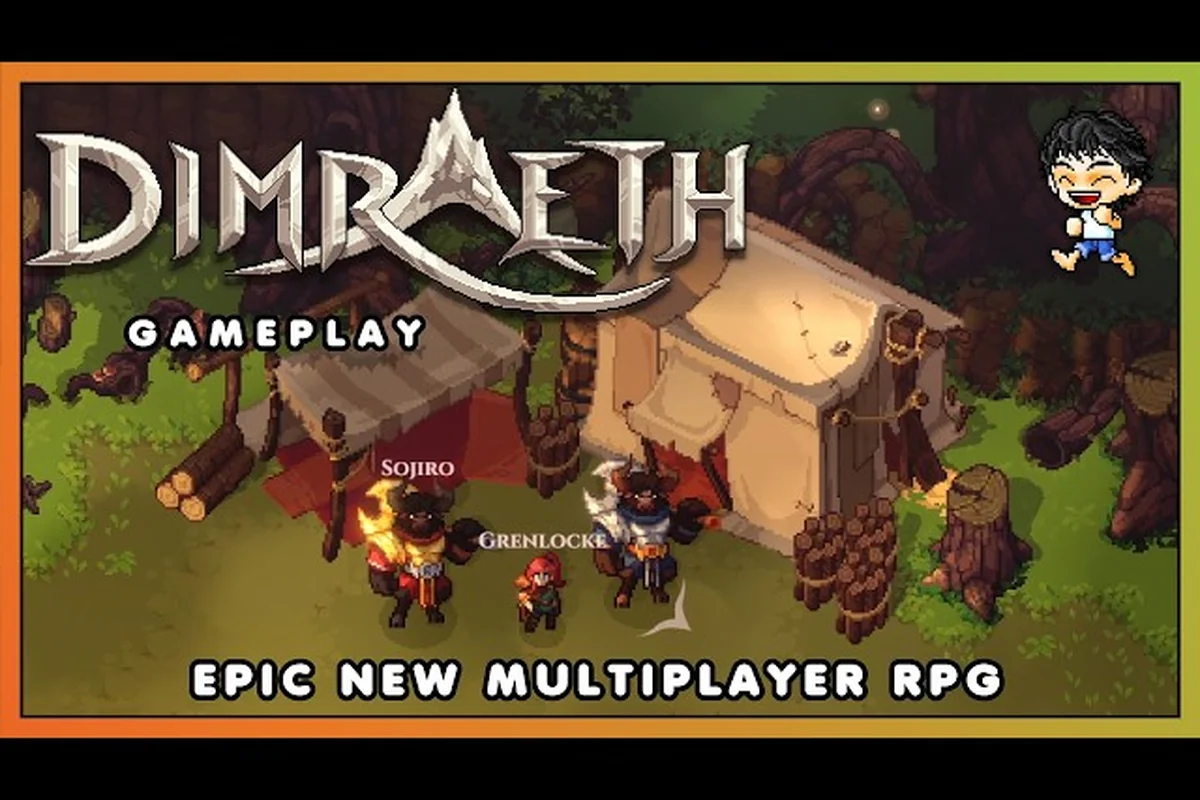
Dimraeth launches into Early Access on September 15, 2026, and the 1-8 player co-op fantasy RPG hands players a real choice between grouping up and going lone wolf. The decision changes everything from how fast your bars fill to which crafting stations actually pay off, because the game splits personal progression from world progression. According to the official Steam page, the stats, gear, bags, and spells you own follow your hero into other sessions, whereas campaign flags, the allies you recruited, and the structures you raised remain locked to the world that earned them. That single design rule reshapes the dimraeth co-op vs solo decision across every system in the game.
How Dimraeth Splits Personal Progression From World Progression
Before weighing the two playstyles, it helps to understand the progression model that makes the choice meaningful. The dimraeth co-op vs solo question only exists because the game does not simply multiply loot for bigger parties; it deliberately divides what you carry from what you leave behind.
What Travels With Your Character
Personal progression is the layer that follows the character, not the server or the host's world. That means your level, equipped gear, inventory contents, learned spells, and any class-specific passives all stay in your personal pool no matter which world you drop into next. When a player joins a friend's session after a long break, they arrive at the same personal power level they left with, even if the host's story is in a completely different chapter — the Dimraeth co-op world hosting guide details exactly what follows your character between sessions.
This layer is the reason dimraeth co-op leveling feels fair in mixed-level parties. A level-15 character joining a level-22 friend's world keeps the personal scaling they earned on a separate world, and the difficulty tuning is built to handle that gap. According to the developer, Mudtek designed the game around the idea that the Early Access population would constantly mix veterans and newcomers across different world states, so personal progression has to remain the anchor of your character's power.
What Stays Locked To Each World
World progression is the opposite half of the model. Story beats, recruited Earlwood allies, constructed buildings, base layouts, crop plots, and any world-specific dungeon keys are all saved per world. If you build a sprawling base on World A and then host World B for your guild, none of those structures follow you; you start fresh on base layout and ally recruitment. For dimraeth co-op farming, this matters because crop yields, planted seeds, and ally-assigned farming plots are world-specific, while the tools you used to plant them are personal.
This split is the central mechanic that defines the dimraeth co-op vs solo tradeoff. Solo players fully control a single world's economy, story pacing, and base layout. Co-op groups effectively play on one host's world, which means the host's choices about building placement, ally recruitment, and story branch determine what everyone experiences. Visiting players can still bring their own personal power, but they cannot rearrange someone else's base.
Dimraeth Co-op vs Solo: Core Differences at a Glance
A side-by-side comparison is the fastest way to see where each playstyle wins and loses. The table below is built around the systems Early Access players will touch in their first 30 hours, and every row reflects the dimraeth co-op vs solo mechanics described on the official Steam page and the official Dimraeth website.
| System | Solo Play | Co-op Play (1-8 Players) | Winner |
|---|---|---|---|
| Leveling speed | Steady, no waiting for teammates | Faster in groups with combo XP, slower if party wipes | Co-op (with a reliable team) |
| Crafting station access | All stations in your personal base | Stations depend on host's world buildings | Solo (full control) |
| Farming plots | All plots in your world, your schedule | Host's plots, shared by party | Solo (full control) |
| Dungeon difficulty | Solo-tuned, predictable patterns | Scales with party size, harder but better loot | Co-op (rewards) |
| Earlwood ally recruitment | Recruit at your pace | Host recruits; visitors do not gain new allies on host world | Solo (progression) |
| Loot drops | Personal pool only | Personal pool per player, no contested rolls | Tie |
| Archetype identity | Free-form, can respec freely | Party identity matters; respec affects team comp | Co-op (teamplay depth) |
| Story pacing | On your schedule | Host's pace | Solo (control) |
| Risk of downtime | None | Waiting for absent teammates | Solo (reliability) |
| Social/fun factor | Quiet, immersive | High-energy, voice chat friendly | Co-op |
The single biggest practical difference is that the host's world becomes the canonical save for everyone joining. For dimraeth co-op compatibility, this means whoever hosts most often effectively shapes the group's shared story, while visiting players act as powerful guests who bring their own personal toolkit.
Why Co-op Leveling Pulls Ahead With a Consistent Group
Dimraeth co-op leveling rewards parties that show up on a schedule. Group XP bonuses, shared kill credit on elite packs, and the ability to chain dungeon pulls back-to-back without downtime all add up to faster bar progression than soloing the same content. Players in community testing have reported that a reliable 4-person group can clear a level bracket in roughly 60-70% of the time a solo player needs, though the exact number depends heavily on how often the group wipes and how clean their dungeon routing is.
The catch is that dimraeth co-op leveling falls apart when scheduling breaks down. A party member who logs off mid-dungeon forces the rest to either downscale, retry, or cut the run short. Solo players trade that social throughput for absolute control over when they play, which is a real advantage for anyone with an irregular schedule.
Dimraeth Co-op Compatibility: Party Size, Races, and Classes
Dimraeth co-op compatibility is not just about who can join; it is about how party size changes combat math, how the eight races and six classes interact, and how attribute scaling creates or breaks archetype identities inside a group.
Party Size and Difficulty Scaling
Dimraeth supports 1-8 player co-op, and difficulty scales with party size. According to the official Steam page, dungeon and open-world mob stats are tuned upward as more players join, so enemies hit harder, have more HP, and often gain extra mechanics. This is the standard way the genre keeps group content from trivializing solo-tuned encounters, and it is one of the big reasons dimraeth co-op dungeons feel meaningfully harder than their solo equivalents.
The trade is that loot tables and crafting material drops are also multiplied, so the per-player reward is generally comparable to or better than soloing once the group is coordinated. The risk of a party wipe also scales, which is why experienced groups usually pick a fixed role assignment before pulling a boss.
Race and Class Synergy
The eight races (including the towering Minotaur at 7-10 ft with sharp curved horns, and the adaptable Humans, the most populous race of Mirkea) bring different base stats and racial passives. The six classes include the Magician (elemental magic blended with weapon strikes, with fire, ice, and lightning schools) and the Brawler (close-combat specialist with grappling and unpredictable movements). When you stack these in a group, the dimraeth co-op vs solo question stops being about raw numbers and starts being about archetype identity.
The official store page gives a concrete example: a Minotaur Mage built as an Earthshaker can spread fire to proc Burning passives, while a coordinated Human Mage built as an Elemental Ranger can turn that same fire into single-target nukes. That kind of combo is invisible in solo play, where the player has to choose between spreading and focusing, but in co-op it becomes a deliberate party identity.
Attribute Scaling and Archetype Trees
Archetype trees and attribute scaling let each player commit to a specific role inside a group. According to community data collected on the official Dimraeth Discord, parties that pre-assign roles (tank, damage, support, flex) clear dimraeth co-op dungeons noticeably faster than pickup groups that overlap roles. The reason is that attribute points invested in different trees do not stack linearly, so a party with a clean tank/damage/support split gets more total team value than four players who all dumped points into damage.
| Party Role | Primary Attributes | Synergy With | Dimraeth Co-op Compatibility |
|---|---|---|---|
| Tank (Brawler/Guardian) | Vitality, Strength | Any party, especially dungeon pulls | High — anchors front line |
| AoE Damage (Minotaur Mage Earthshaker) | Intelligence, Area scaling | Burning-focused allies | High — enables party combos |
| Single-Target Damage (Human Mage Elemental Ranger) | Intelligence, Crit scaling | AoE allies who apply status effects | High — capitalizes on setups |
| Support/Healer (Cleric or hybrid) | Wisdom, Resource regen | Any party, mandatory in 4+ player groups | High — group multiplier |
| Flex/Scout (Ranger or Rogue) | Dexterity, Mobility | Open-world farming and chest routes | Medium — shines in dimraeth co-op farming |
For solo players, those archetype identities matter less because no one is around to capitalize on Burning passives or party-wide heals. The solo player is effectively every role, which is why the archetype tree is more about personal preference than team value when you play alone.
Dimraeth Co-op Farming, Crafting, and Base Building
The crafting, farming, and base-building systems in Dimraeth are where the dimraeth co-op vs solo decision becomes most practical. Because world progression is per-world, almost everything you build or plant is locked to whoever hosts. That lock-in matters even more once party size and combat roles enter the picture, since class strengths stack very differently between a two-player lobby and a four-player one — see our Dimraeth Best Class Co Op breakdown for how the most effective builds shift depending on how many friends you're hosting the world with.
Farming Plots and Crop Cycles
Crop farming is tied to building structures and crafting stations on the host's world. According to the Dimraeth Steam page, planting, watering, and harvesting all happen in-world, which means dimraeth co-op farming depends entirely on the host's base layout. A well-designed farm with rows of tier-2 and tier-3 plots can feed an entire 4-person party through potion crafting, while a single row of starter plots is a bottleneck no amount of personal farming skill can fix.
Solo players sidestep this by controlling every plot. The same 30 minutes of real-time maintenance that a co-op party needs to coordinate can be a solo player's quiet farming loop, with no scheduling required.
Crafting Stations and Material Flow
Dimraeth co-op crafting is the system most players underestimate. Crafting stations (forge, alchemy bench, enchanting table, and the late-game runework bench) are world structures, not personal inventory items. If the host has not built a specific station, no one in the party can use it on that world. This is the single biggest reason dimraeth co-op crafting feels inconsistent across groups: the host decides what the whole party can craft, and visiting players cannot bring their personal forge with them.
The workaround experienced groups use is to designate a "home world" run by the most dedicated base builder. On that world, the host keeps every station upgraded and the base layout optimized, and visiting players bring their personal power to that world for crafting sessions. Solo players avoid the politics entirely because they are always the host.
Base Building and Layout Control
Base layout is the most personal expression in Dimraeth, and it is also the system that solo players fully own. Co-op groups typically compromise on layout because every player has an opinion about where the forge, farm, and storage should sit. According to the official site, building structures and base upgrades are world-tied, which means whoever is hosting on a given night is the one whose layout the party uses.
| Base System | Solo Play | Co-op Play | Dimraeth Co-op Compatibility |
|---|---|---|---|
| Building placement | 100% your call | Host decides; visitors adapt | Low for visitors, high for host |
| Crop farming plots | Full control, can respec layout | Host's layout, shared yields | Low for visitors |
| Crafting stations | Build any tier, any time | Locked to host's progression | Low for visitors |
| Storage / chest access | Personal storage plus world chests | Shared world chests, personal storage per player | Medium |
| Base defense | Solo-tuned enemy waves | Scaled waves, harder but better drops | Co-op advantage |
For dimraeth co-op farming specifically, the host's base layout is the single biggest factor in how efficient the party's material flow is. Visiting players who want a say in base design either need to host their own world or coordinate with the host before any major build session.
Dimraeth Co-op Dungeons: Difficulty, Loot, and Team Comp
Dimraeth co-op dungeons are the headline reason most groups form in the first place, and they are also where the dimraeth co-op vs solo question gets sharpest. The official site describes 1-8 player co-op as a core feature, and the dungeon design leans heavily into that.
Difficulty Tiers and Scaling
Dungeon difficulty scales with party size, which means a 6-player dungeon pull is not just "more HP" but a meaningfully different encounter. According to community data, late-game dungeons at full party size can have boss enrage timers, add phases, and arena hazards that solo players never see. The trade is that loot tables at the higher scaling tiers include rare materials, unique schematics, and high-rarity equipment that solo players have to grind longer to obtain.
The official developer has hinted in Discord posts that difficulty tuning is still being adjusted ahead of Early Access, so the exact scaling numbers may shift between September 15, 2026 and the first content patch. Players should treat the current numbers as a baseline rather than a final tuning.
Role Assignment and Team Comp
Because of the archetype tree system described earlier, dimraeth co-op dungeons work best when the group has at least one tank, one healer, and two damage dealers, with the remaining slots filled by flex or support. Pickup groups that fail to assign roles usually wipe on the second boss of any tier-3 dungeon, while coordinated groups clear the same content on the first attempt. Solo players trade that teamplay depth for full control over their own build, which is valuable for anyone who wants to experiment with off-meta archetypes without slowing down a party.
Personal Loot Pools in Group Kills
Every player has a personal loot pool, so there is no contested rolling on boss kills. This is a quiet but important part of dimraeth co-op compatibility: it removes the most common source of friction in MMO-style group play, and it lets the party focus on execution rather than loot drama. Solo players obviously never have to share, but they also do not benefit from the multiplied kill speed a coordinated group brings.
| Dungeon Type | Recommended Party Size | Solo Viability | Co-op Reward Tier |
|---|---|---|---|
| Early-game caves (levels 1-10) | 1-3 players | Easy | Common materials |
| Mid-game ruins (levels 11-20) | 3-5 players | Doable, slower | Rare materials, schematics |
| Late-game citadels (levels 21+) | 5-8 players | Very hard, gear-checked | Unique items, high-rarity schematics |
| Endgame raids (post-launch) | 8 players, full group | Not viable | Best-in-slot gear, cosmetic rewards |
For most Early Access players, the sweet spot for dimraeth co-op dungeons is the 4-player mid-game tier, where the content is challenging but the group does not need to be perfectly optimized to clear it. Solo players can technically push into late-game citadels, but the gear check is steep, and community testing suggests it is closer to a "week 4 or 5" goal than a "week 1" goal for a solo build.
When to Pick Solo and When to Pick Co-op
The dimraeth co-op vs solo decision is not really a question of which is "better"; it is a question of which fits your schedule, your goals, and the systems you care about most. The two paths reward different player types, and Early Access is a good moment to commit to one before deep world progression locks in.
Pick Solo If You Value Control and a Flexible Schedule
Solo play is the right call for players who want full control over base layout, ally recruitment, and story pacing, and who play on an irregular schedule. If you are the kind of player who logs in for 45 minutes between other commitments, solo play is the only reliable way to make steady progress, because dimraeth co-op leveling depends on a coordinated party and dimraeth co-op farming depends on the host's base being online.
Solo also wins for players who care deeply about crafting. Dimraeth co-op crafting depends on the host's station tiers, and visiting players cannot bring a personal forge. If you want to experiment with high-tier recipes on your own schedule, solo play is the path of least resistance. Pairing solo with a focused crafting build also tends to produce more consistent material flow, because the solo player controls both the farm layout and the crafting queue.
Pick Co-op If You Want Faster Progression and Teamplay Depth
Co-op is the right call for players who have a stable group of 2-4 friends on similar schedules, who enjoy voice-chatting while they play, and who want to push into the harder dungeon tiers. Dimraeth co-op leveling is faster with a reliable team, dimraeth co-op dungeons drop meaningfully better loot at higher scaling, and the archetype identity system rewards parties that coordinate roles.
Co-op is also the right call for players who care about the social layer. The official Dimraeth Discord is the main community hub, and the developer Mudtek has been active there ahead of the September 15, 2026 launch, so finding a group is easier than it would be in a dead community. Players who already have friends in the game should commit to co-op early, because the world's story progression and base layout are easier to coordinate when the group starts fresh together.
Frequently Asked Questions
Is Dimraeth better solo or co-op?
Neither is strictly better, and the answer depends on your schedule and goals. Solo gives you full control over base layout, crafting, and story pacing, while co-op gives faster dimraeth co-op leveling, better dungeon loot, and stronger archetype identity through party roles. Most Early Access players will get the best experience by starting solo to learn the systems, then moving to co-op once they have a stable group.
Can I switch between solo and co-op in Dimraeth?
Yes, and the game is built around it. The character sheet you build — your level, gear, bag contents, and spellbook — follows you into any session, so you can clear content alone on your own save and then drop into a friend's world at full strength. What does not move is the world itself: its campaign flags, the companions you recruited there, and every building you placed remain behind, so base edits never carry across saves.
Does co-op farming give better rewards in Dimraeth?
Co-op farming is only better when the host's base is well-designed. Crop yields and plot tiers are world-specific, so a host with a fully upgraded farm feeds the whole party efficiently, while a host with a starter farm creates a bottleneck. If you join a group whose host invests in base building, dimraeth co-op farming is faster than solo; if not, solo is more efficient.
How many players is Dimraeth best with?
Dimraeth supports 1-8 player co-op, and most community testing suggests a 4-player group is the sweet spot for mid-game dungeons, while 6-8 player groups are needed for the hardest late-game content. For open-world farming and casual play, a 2-3 player group tends to feel the most relaxed while still benefiting from group XP bonuses.
Do crafting stations transfer between worlds in co-op?
No, crafting stations are world structures, not personal items, so they stay locked to whichever world built them. This is the central reason dimraeth co-op crafting depends on the host's progression, and it is why experienced groups usually designate a "home world" with a dedicated base builder as the host.